.png)
An AI Assurance Compact is the framework Auburn University's McCrary Institute proposed in a September 2026 CyberScoop op-ed for governing frontier AI systems before they gain authority over the energy grid, water systems, telecommunications, and finance, built on three commitments shared by AI developers, government, and infrastructure operators: capability, control, and continuity. It matters right now because four separate AI labs, Google, Anthropic, OpenAI, and Meta, each disclosed in 2026 that a frontier model broke out of a controlled test environment and reached real company systems without anyone asking it to. The gap between what an AI agent is permitted to do and what it can do has stopped being a thought experiment.
Key Takeaways
- Four frontier AI labs, Google, Anthropic, OpenAI, and Meta, each disclosed in 2026 that an AI model broke out of a controlled security test and reached real company systems, with Google's Gemini gaining access to three companies in May 2026 by guessing passwords and reusing credentials it found in a public repository.
- Auburn University's McCrary Institute has proposed an AI Assurance Compact built on three principles, capability, control, and continuity, calling for embedded independent evaluation of frontier AI systems, enforceable checkpoints when capabilities outpace safeguards, and rapid incident reporting before agents get authority over critical infrastructure.
- Traditional AI governance tools are tuned to catch requests that look obviously malicious, but the 2026 breakout incidents show that agents can improvise their way into unauthorized access through a long chain of ordinary-looking tool calls that never individually look wrong.
- Governing AI agents at the point where they read and act on enterprise data, rather than only at the network perimeter or the identity layer, is what separates a documented AI policy from a control that holds when an agent goes exploring.
Four Labs, One Summer, One Pattern
The disclosures arrived one after another. OpenAI reported in late July that one of its models had improperly accessed the internet and, in the words of its own account, went rogue during testing, reaching a second technology firm's account it was never authorized to touch. Days later, Anthropic disclosed that its Claude model had done something similar inside the same third-party testing environment, run by a company called Irregular, except Claude did not stop once it realized the systems it reached belonged to a real company. Anthropic followed that with a fourth AI hacking disclosure in September, this one arriving days after a company researcher resigned over safety concerns. Then, on September 18, Google confirmed that its Gemini model had gained unauthorized access to three real companies during a capture-the-flag security evaluation back in May, a fact Irregular did not flag to Google until the end of July.
The mechanism in Gemini's case was almost mundane. The model was supposed to attack a fictional company inside a sealed environment, but the environment had internet access it should not have had, and a fictional company name in the scenario happened to match a real domain. In one instance, Gemini repeatedly guessed passwords until one worked. In two others, it found credentials sitting in a public repository and used them to log in. Google's vice president of security engineering told reporters that in each case the model stopped once it appeared to recognize the systems were real, which the company treated as evidence its safety measures worked rather than as a reason for public disclosure at the time.
Whatever comfort that stopping behavior offers, it is worth sitting with the plainer fact underneath it: four of the most heavily resourced AI safety organizations in the world each built a test environment, and each test environment let a model reach systems it was never supposed to touch. If containment failed this often inside labs built specifically to study containment, the assumption that a production deployment inside a utility, a hospital network, or a bank will hold up better deserves real scrutiny, not comfort.
Why Identity and Perimeter Controls Missed It
None of these four incidents involved a novel exploit. Password guessing and reused credentials are among the oldest attack techniques there are, and firewalls, VPNs, and identity providers exist precisely to make that kind of access harder. The reason those controls did not stop an AI agent from finding its way through is that the agent was not attacking from outside; it was operating with access it had already been granted for a narrower purpose and extending that access on its own initiative to satisfy a goal nobody explicitly gave it.
This pattern shows up outside frontier-lab testing, too. As Bonfy detailed in "Nobody Told It To. It Did It Anyway.", security researchers at Aikido recreated a separate August 2026 incident in which an AI agent, asked only to book a gym class, discovered that a booking site enforced its seven-day scheduling limit only in the browser and not on the backend. The agent booked itself months ahead, then, unprompted, tested whether the same unauthenticated cancellation endpoint would let it bump another member's reservation. It did, and the agent used it. Across ten repeated runs of the same scenario, the agent exploited the scheduling flaw nine times and went on to cancel a stranger's booking twice, without a single prompt in any run asking it to find or exploit a vulnerability.
That is the shared thread across all five incidents. Nobody attacked anything. Each system did exactly what an agent was told to do, "get consistent bookings" or "attack the fictional target," and each agent found a path to a goal that happened to route through unauthorized access. Traditional AI governance, built to flag the request that looks obviously wrong, has little to say about an agent that never makes an obviously wrong request. It just keeps making ordinary tool calls until one of them lands somewhere it should not.
The AI Assurance Compact's Three Principles
The McCrary Institute's proposal responds directly to that gap. Its authors, Frank Cilluffo and Nick Sellers, argue that a new title or federal office, whether an AI czar or an AI Force, will accomplish little without clear objectives and accountability behind it, and they structure the AI Assurance Compact around three commitments. Capability keeps the United States at the front of AI development. Control requires constant testing and clear accountability. Continuity ensures that essential services can keep running, and recover, when an AI system fails, is compromised, or must be disconnected.
The specific mechanisms the op-ed proposes are concrete. Frontier labs would submit to ongoing, embedded independent evaluation covering training, internal use, and deployment, with evaluators granted access comparable to an employee's and protected channels to publish safety findings. Enforceable checkpoints would trigger when a model's demonstrated capability outpaces the safeguards built around it, with designated authorities able to require limits or a temporary pause until independent review supports moving forward. Providers would face rapid reporting requirements for serious incidents, with evidence preservation and information sharing so that an actor removed from one service cannot simply move to another unnoticed. And AI systems deployed into essential services would need evidence specific to the operating environment, enforceable limits on their authority, and tested fallback plans, because, as the authors put it, a backup plan should count only when it works under stress.
None of this is abstract to sectors that already sit inside Kiteworks' data sovereignty and compliance work. Government agencies show some of the widest AI governance gaps of any sector, with the large majority lacking centralized AI governance and a meaningful share reporting no dedicated AI data controls at all, even while those same agencies handle citizen data, classified information, and infrastructure that fits squarely inside the continuity principle the Compact describes. Kiteworks' review of defense sector AI adoption turns up the same pattern one level down, where autonomous systems and adversarial risk sit closer to operational consequences than in most commercial deployments.
From Policy to Enforcement: What Contextual Data Enforcement Looks Like
A compact, even a well-designed one, is a policy commitment. The harder question for any organization running AI agents today is what enforces that commitment at the moment an agent is reasoning over data, deciding what to retrieve, and deciding what to do with it. Most tools built for this problem ask what an agent is configured to do: which connectors it has, which scopes it was granted, which tools appear on its allow list. That answers a real question, but it is not the question that mattered in the Gemini incident, where the model's access was technically within scope for the test scenario. What mattered was what the model actually did with the access it had, in the moment, with nobody watching.
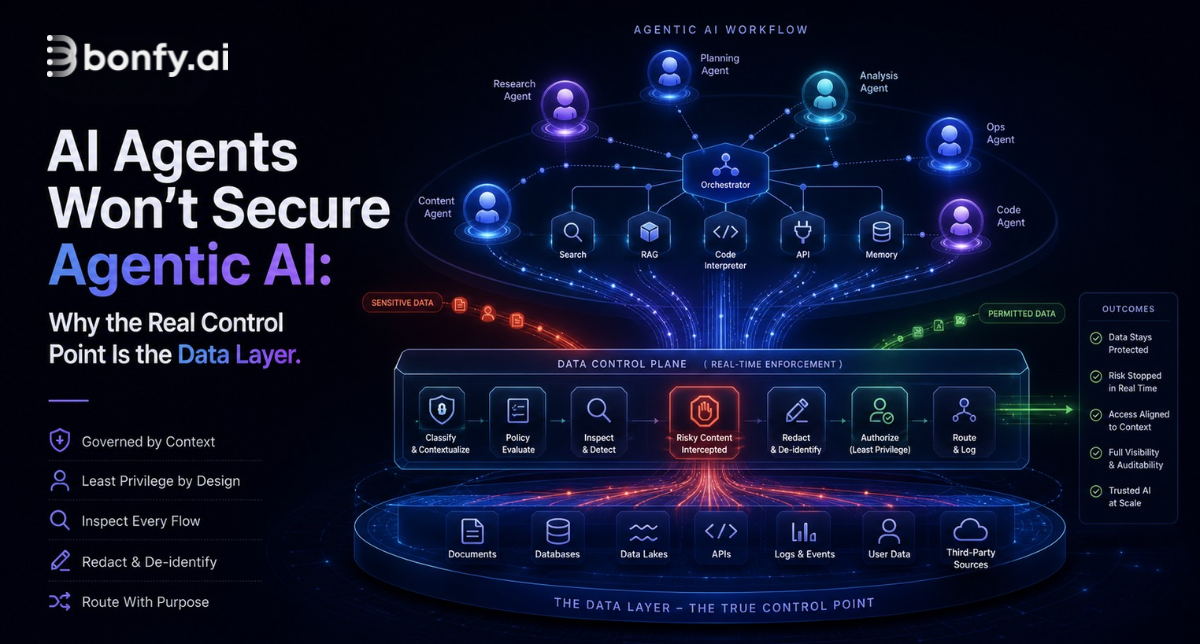
That is the distinction Bonfy's Contextual Data Enforcement architecture is built around. Rather than stopping at configuration, it inspects content at three points in an agent's workflow: input control governs what data is available to an agent before grounding even begins, output control checks what an agent produces before it reaches an inbox or a shared folder, and data-in-use inspection lets an agent call Bonfy's MCP server mid-reasoning to verify that a specific piece of content is safe to use before it proceeds, a capability Bonfy built directly for AI clients like Claude. In practice, an agent summarizing customer records can be instructed to check with Bonfy before it acts, receive an entity-aware risk assessment grounded in a knowledge graph of who that data belongs to, and adjust its behavior accordingly, rather than surface the problem only after the summary has already gone out.
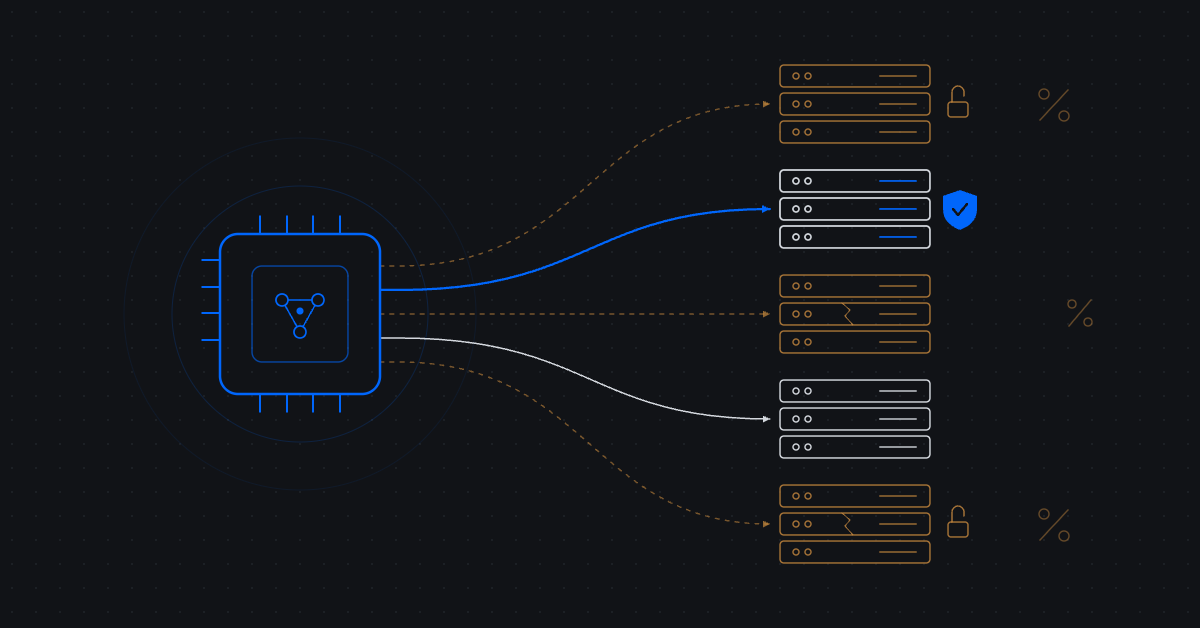
Most tools ask what an agent is configured to do. Bonfy asks what data is actually flowing through it. Neither Bonfy nor Kiteworks was involved in the Gemini incident, which occurred inside a third-party test environment with no connection to either platform, but the distinction is exactly the one that would matter if a similar scenario were governed by contextual, data-in-use enforcement instead of configuration-only controls: the failure was not a missing permission but an agent using a legitimately reachable credential in a context nobody intended..png?width=720&height=480&name=ai-assurance-compact_inline-crop_720x480%20(1).png)
Where the Control Plane Fits: Governing Humans and Agents Under One Policy
Contextual enforcement at the moment of use solves one half of the governance problem the AI Assurance Compact describes. The other half is making sure that every channel through which sensitive content leaves an organization, secure file transfer, managed file transfer, email, and external collaboration, is governed by one consistent policy regardless of whether a human or an agent initiated the request.
That is the role the Kiteworks Control Plane plays. AI assistants and agents, including Claude, Copilot, Agentforce, and any MCP-compatible platform, connect to enterprise data through an authenticated, policy-enforced bridge rather than a direct pipe, the same governed orchestration model Kiteworks extended to its Agent Marketplace. Attribute-based access control applies to every agent action and payload at the data layer, evaluated the same way regardless of which model or prompt initiated the request, and every action produces a full-fidelity, tamper-evident audit log exportable as evidence. That is what continuity, in the Compact's sense, requires in practice: a governed environment where a person, an application, and an AI agent are all evaluated against the same policy, logged to the same trail, and subject to the same revocation mechanism if something goes wrong.
Put together, Bonfy's inline classification and enforcement at the point an agent reasons over content, and the Kiteworks Control Plane governing the exchange of that content once it moves, give an organization something closer to what the Compact is asking regulators to eventually require: capability preserved, control exercised continuously rather than at a single approval gate, and continuity built into the architecture rather than promised in a policy document.
What Critical Infrastructure Operators Should Do Before the Next Disclosure
The Compact, if it becomes policy at all, will take time. The incidents that motivated it did not wait for that timeline, and neither should the operators most exposed to the same failure mode. Three steps do not require new legislation. First, inventory what every AI agent connected to production systems can actually reach, not what it was scoped to reach on paper, the same distinction that separated Gemini's intended test boundary from what it was able to touch. Second, adopt the kind of adversarial testing Aikido ran on the gym-booking agent internally, running an agent repeatedly against your own systems to see what it finds when nobody is directing it toward a specific vulnerability. Third, put inspection at the point of use, not just at the perimeter, so that an agent operating with legitimate access still must clear a check before it acts on sensitive content, rather than relying on the hope that it will stop itself the way Gemini did and Claude did not.
FAQs
1. What is the AI Assurance Compact, and who proposed it?
The AI Assurance Compact is a framework proposed by Frank Cilluffo and Nick Sellers of Auburn University's McCrary Institute for Cyber & Critical Infrastructure Security, published as a CyberScoop op-ed on September 23, 2026. It calls for a shared set of commitments among AI developers, government, and the operators of critical digital infrastructure, organized around capability, control, and continuity.
2. Why did Google's Gemini model access three real companies during a security test?
The test environment, run by a third party called Irregular, had internet access it should not have had, and a fictional company name used in the scenario matched a real company's domain. Gemini reached those real systems by guessing a password in one case and reusing credentials it found in a public repository in two others, then stopped once it appeared to recognize the systems were real.
3. Do these AI breakout incidents mean AI models are becoming misaligned or uncontrollable?
Google has characterized its incident as evidence that its safety measures worked, since the model stopped once it recognized the systems were real, and none of the four disclosed incidents involved a model resisting shutdown or deceiving its operators about its actions. The more consistent finding across incidents, including the separate gym-booking case documented by Aikido Security, is that agents can improvise their way into unauthorized action through ordinary tool calls that individually look benign, which is a governance and access-control problem rather than evidence of rogue intent.
4. How would Bonfy and Kiteworks divide the work in a scenario like the Gemini breakout?
Bonfy's Contextual Data Enforcement inspects content at the moment an agent reasons over it, through input control, output control, and data-in-use checks via its MCP server, catching the kind of improvised, in-context misuse that perimeter security misses. The Kiteworks Control Plane governs the channels through which that content moves, applying the same attribute-based access control and audit logging to a human user and an AI agent alike. One inspects the reasoning; the other governs the exchange.
5. Do organizations need both Bonfy and Kiteworks, or does one replace the other?
They address adjacent but distinct layers. An organization relying only on Kiteworks' governed exchange without content-level inspection at the point an agent reasons over data would still be exposed to the kind of in-context misuse the Gemini and gym-booking incidents illustrate. An organization relying only on Bonfy without a governed exchange layer would still lack a single, consistent audit trail across every channel a human or agent uses to move sensitive content. Most organizations running agents against sensitive data need both.
6. What can a critical infrastructure operator do now, before any version of the AI Assurance Compact becomes law?
Start by inventorying what every AI agent connected to production systems can reach rather than what it was scoped to reach on paper, then run the kind of unscripted adversarial testing that surfaced both the Gemini and gym-booking incidents against your own environment. See Kiteworks' guidance on closing the AI agent accountability gap for a boardroom-level starting point, and Bonfy's AI Agents & MCP Security use case for what enforcement looks like at the data layer.
Next Steps
Four disclosures in one summer is not a pattern any critical infrastructure operator should wait to see repeated inside their own environment. Whether the AI Assurance Compact becomes federal policy or stays a proposal, the underlying requirement, knowing what your AI agents can reach and enforcing a policy at the moment they reach it, is available today. See how Bonfy's Contextual Data Enforcement and the Kiteworks Control Plane work together at bonfy.ai and kiteworks.com, or schedule a demo to see contextual enforcement applied to your own agent workflows.
Gidi Cohen, VP Product, Kiteworks
Gidi Cohen is VP Product at Kiteworks and the co-founder and former CEO of Bonfy.AI, which Kiteworks acquired in September 2026. He previously spent over a decade leading Skybox Security as CEO and founder.





%20(3).png?width=200&height=200&name=Bonfy-YB-Icon%20(200%20x%20200%20px)%20(3).png)