
Anthropic’s “Claude Mythos” leak is not just a story about one company’s CMS misconfiguration, it is a preview of what happens when AI-era data flows outpace AI-era data security. For enterprises (nearly all of them) racing to adopt copilots, AI agents, and new tools like Claude Code Security, the lesson is clear: the weak point is not the model, it is the unstructured data and workflows, including governance, around it.
From CMS Misconfigurations To AI Data Chaos
What Happened?
On March 26/27, 2026, Anthropic experienced a significant data leak, accidentally exposing details about their most powerful in-development AI model, codenamed "Claude Mythos" (sometimes referred to in documents as a new tier named "Capybara"). The leak occurred when draft blog posts and approximately 3,000 internal documents were left in an unsecured, publicly searchable data store due to "human error" in content management system (CMS).
The Anthropic incident reportedly exposed thousands of internal assets (drafts, research, event details) through a simple configuration error in a content system. This is exactly the kind of “ordinary” mistake that becomes extraordinary in an AI-first world, where:
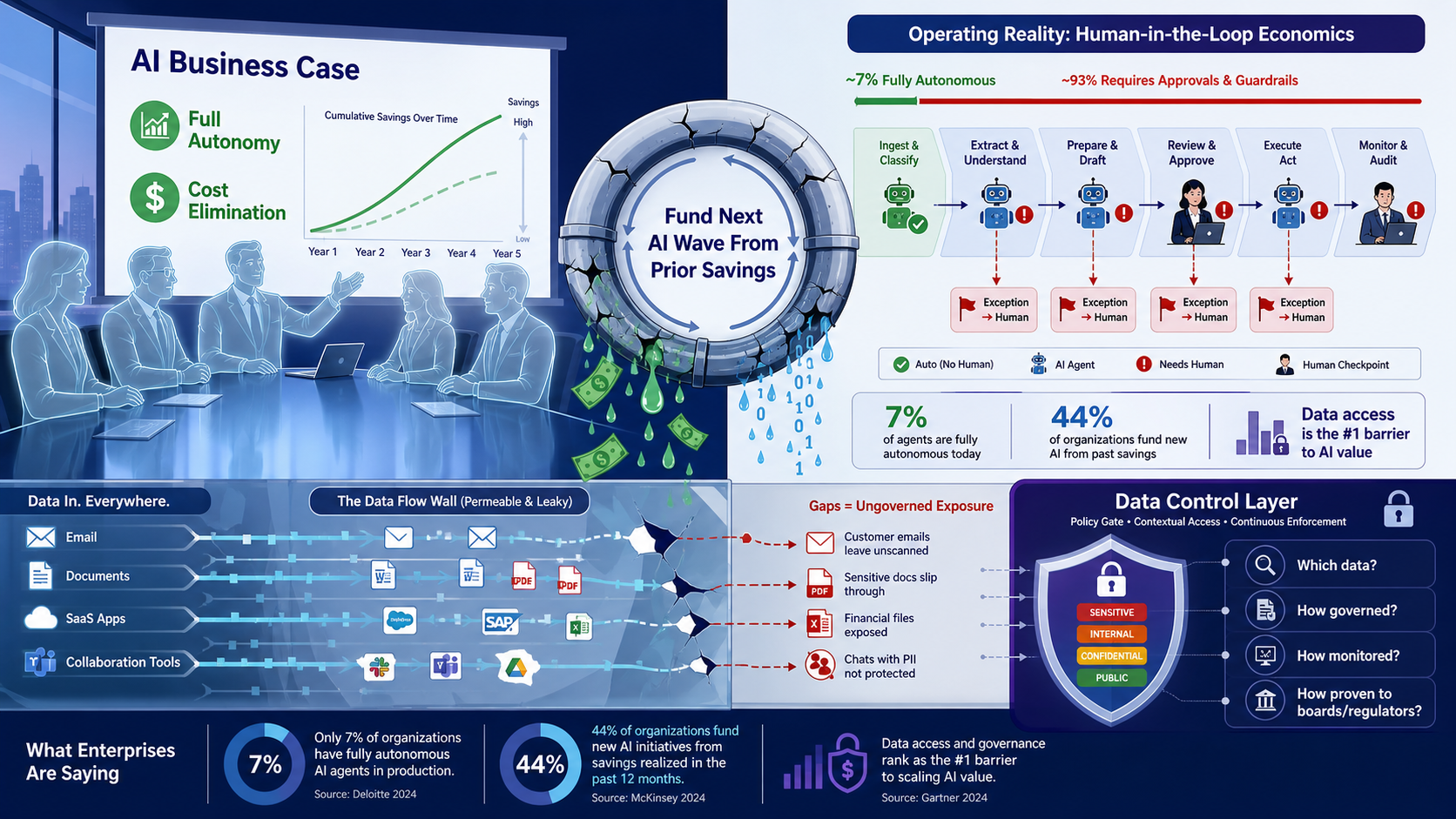
- Information moves through complex, multi-hop flows spanning email, SaaS apps, collaboration tools, LLMs, and increasingly autonomous agents.
- Sensitive content is continuously ingested, transformed, and regenerated at scale, often without unified visibility into what AI systems are accessing, indexing, or outputting.
- Traditional DLP and DSPM tools, built for static rules and predictable channels, were never designed to monitor AI prompts, embeddings, vector stores, or agent-to-agent workflows.
A misconfigured CMS may sound boring, but when that content is also training or grounding AI systems, or feeding executive retreats, new model launches, or customer-facing assets, the blast radius expands far beyond “just another web exposure.”
AI Security Is About Data and Entities, Not Just Models
The market reaction to Anthropic’s new security tools and this latest leak reflects a deeper anxiety: not about the breach itself, but about these AI leaders pushing further into cybersecurity and competing more directly with established vendors
The answer is not to slow AI down; it is to change how data security is done:
- Legacy tools lack business and entity context, so they cannot distinguish generic content from customer-, consumer-, or deal-specific information that carries real regulatory and trust risk.
- Most “AI security” offerings today focus on configuration (what agents exist, which tools they can call, what permissions are set) rather than on the actual content flowing through those agents and systems.
- Enterprises need unified, multi-channel visibility that spans email, files, SaaS apps, collaboration tools, copilots, AI agents, and custom LLM applications through a single, contextual lens.
In other words, securing AI means securing the data plane: what content AI systems can see, what they retain, what they generate, and how those outputs move across the organization.
How Bonfy Protects The AI Data Plane
Bonfy is an AI Data Security platform that protects unstructured data everywhere it moves - email, files, SaaS apps, collaboration tools, copilots, AI agents, and internal AI-enabled systems. The platform is built from the ground up for the AI era, combining:
- Multi-channel architecture that covers data in motion, at rest, and in use across major SaaS platforms, communication channels, file repositories, AI systems, and agents.
- An entity-aware analysis engine that understands the people, customers, and consumers behind the data, dramatically improving detection accuracy and reducing false positives so real prevention is possible.
- A unified control plane that orchestrates discovery, classification, labeling, remediation, and enforcement with one policy engine across human and AI-driven workflows.
As AI becomes embedded in everything from productivity suites to support workflows and executive decisioning, Bonfy enables organizations to adopt these capabilities without flying blind.
Upstream And Downstream AI Guardrails
Bonfy’s approach to AI risk covers the full lifecycle of content:
- Upstream: Controlling what sensitive or regulated content is even available to AI systems (grounding) through granular, contextual labeling and access controls on sources like SharePoint, Google Drive, and other repositories.
- In use: Inspecting prompts, retrieved documents, embeddings, and intermediate agent data in real time to ensure AI systems and agents do not process or propagate high-risk content without guardrails.
- Downstream: Monitoring and enforcing policies on AI-generated outputs as they are shared via email, collaboration platforms, file-sharing tools, or exposed through apps and portals.
This data-centric approach ensures that even if a configuration slips, such as a CMS setting, an over-privileged agent, or a mis-scoped copilot, sensitive content is still governed by policies grounded in real business context.
Now, not in the future: Securing AI Agents And MCP Workflows
If Anthropic’s Claude Code Security rattled markets, the coming wave of AI agents will fundamentally reshape the risk surface. Agents orchestrate LLMs, internal systems, and external tools (including MCP servers) to plan, reason, and take actions on behalf of users and systems.
That creates multiple new leakage points:
- User-to-agent prompts that may include confidential, customer-specific, or regulated data.
- Agent data access to SaaS systems and file stores, where oversharing can silently break trust boundaries.
- Communications with external MCP servers that may receive or return sensitive information that was never meant to leave the organization.
- Outbound channels (emails, files, tickets, or messages) where agent-generated outputs can expose internal details at scale.
Bonfy addresses these risks with three layers of control, all powered by the same platform intelligence:
- Input control: Inspecting and governing content flowing into AI systems and agents, including what data is used for grounding and retrieval.
- Output control: Inspecting what AI systems and agents produce before it is sent externally or published, preventing accidental or hallucinated leakage.
- Data-in-use inspection via Bonfy’s own MCP server: Agents can call Bonfy during their reasoning process to ask, “Is this content safe to use or share?” and adjust execution based on policy-aware risk feedback.
This last piece is critical: instead of trying to bolt security onto the perimeter of agent frameworks, Bonfy makes data security a native part of the agent’s decision loop.
The Reality
Anthropic’s “Claude Mythos” leak underscores a fundamental reality: AI has accelerated the value of data, but it has also amplified the consequences of getting data governance wrong. The winners in this next phase will not be the enterprises that pause AI, but those that put AI-grade data security in place, so they can innovate faster than the market, without inheriting the next headline-making leak.
Bonfy exists to be that AI Data Security foundation.






%20(3).png?width=200&height=200&name=Bonfy-YB-Icon%20(200%20x%20200%20px)%20(3).png)