
TL;DR:
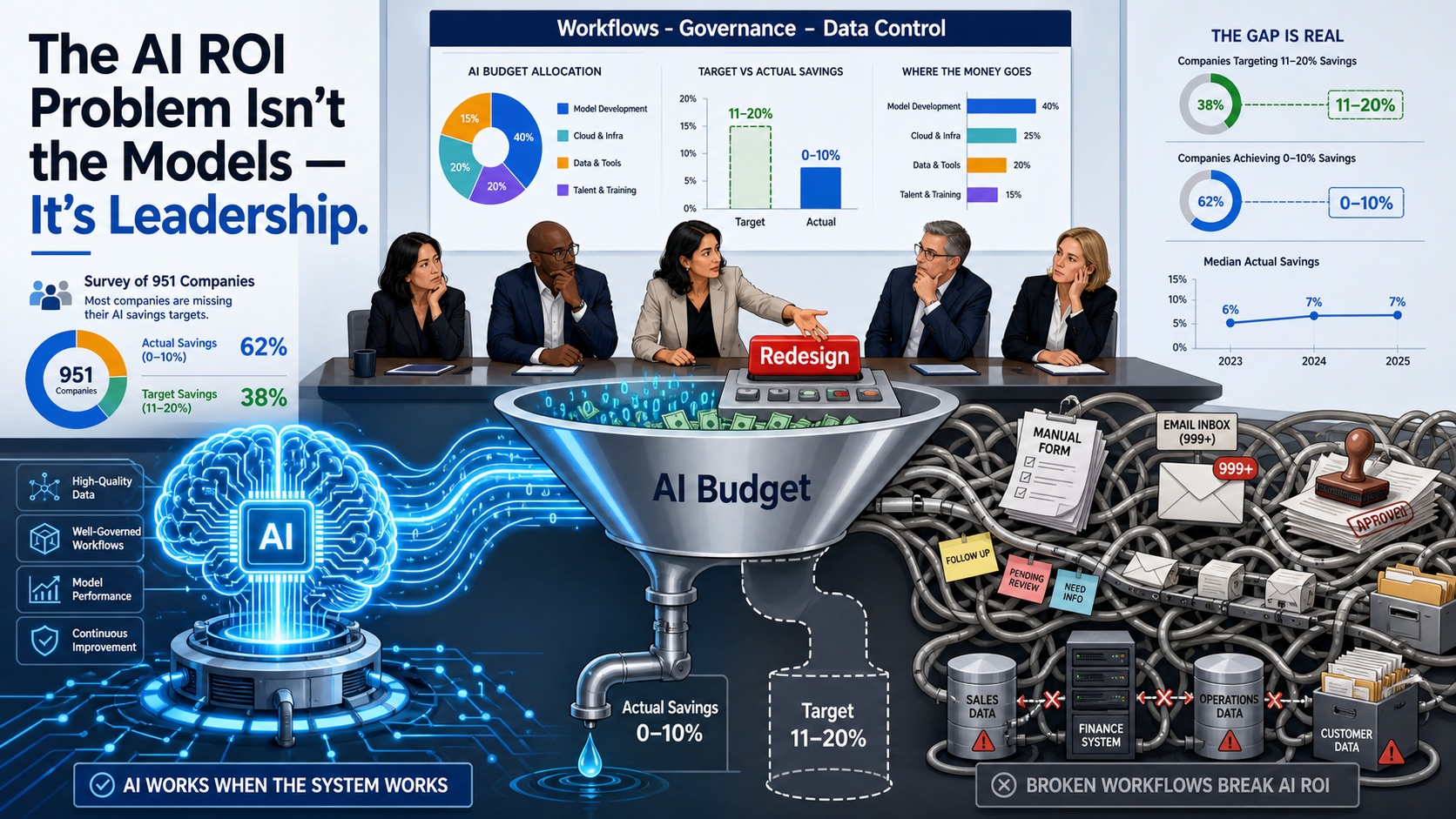
Bain’s 2026 Automation & AI Pathfinder Survey shows a clear pattern: AI budgets are climbing, but most companies are landing in the 0–10% savings range, far below their 11–20% targets. That gap isn’t a technology failure. It’s a leadership failure to redesign workflows, governance, and data control for an AI era.bain
**************
AI isn’t failing because the models are weak.
It’s failing because leaders are comfortable approving bigger AI budgets and deeply uncomfortable owning the conditions required for those investments to pay off.
Bain’s 2026 Automation & AI Pathfinder Survey put numbers to what many executives already feel. Across 951 companies, 37% targeted cost reductions of 11–20% from AI, yet nearly 40% of those who measured outcomes landed in the 0–10% bucket instead. The technology largely did what it was supposed to do. The value did not arrive at the scale the business case promised.
Despite this, 90% of those same companies are now increasing their AI budgets again, including investments in more autonomous agents with greater impact on core processes. That’s not irrational enthusiasm; it’s a sign of a deeper illusion about where AI’s problems actually sit.
The AI ROI Illusion
The comfortable story is that AI hasn’t yet “lived up to the hype.”
Boards approve another wave of spending—RPA, machine learning, GenAI, agents—and assume the next wave will finally unlock the promised savings. When the numbers disappoint, the explanation is usually framed around model quality, vendor selection, or “early stage” technology.
Bain’s data points elsewhere. The gap shows up not because the models fail, but because the organizations that deploy them rarely change how work is structured. They drop AI into existing workflows, bolt it onto legacy processes, and hope efficiency will magically appear. AI becomes a layer on top of old operating habits rather than a catalyst for a new way of working.
In that world, agents route decisions to human queues that were never redesigned. Approvals and exceptions pile up without clear ownership. Data lives in fragmented repositories without a coherent access strategy. Risk increases as more systems and content are connected, but accountability for AI’s decisions stays fuzzy.
The result is predictable: measurable savings stay low, even as infrastructure and integration costs rise.
Leadership, Not Models, Is the Real Choke Point
Bain’s study also highlights that the companies realizing their targets look different in one key way: they treat data access, governance, and process redesign as CEO‑level problems, not IT problems. They don’t start with “Which AI tools can we buy?” They start with “How should this process work if we were designing it today?” and “Who is accountable when AI makes a consequential mistake?”
In other words, they accept that AI underperformance is organizational, not technological.
The organizations that remain stuck in the 0–10% savings band are choosing, implicitly, not to do that work. They approve business cases built on full‑automation assumptions while running human‑in‑the‑loop reality. They permit AI to expand their data surface without putting in place a control layer that governs how AI interacts with sensitive content. They treat AI as a line item rather than a mandate to redesign roles, workflows, and decision‑making.
The next AI cycle will sort companies into two groups: those whose leadership is willing to do that uncomfortable organizational work, and those who keep investing in tools without changing how the organization operates.
If your AI ROI looks more like Bain’s underperformers than its leaders, it’s time to ask a different question. Not “Which model should we try next?” but “What have we actually changed about our workflows, our governance, and our data control to make AI success possible?”
The second blog in this mini‑series looks directly at the fiction inside most AI business cases—and why ignoring data risk and control is quietly eroding both ROI and trust.


.png)




%20(3).png?width=200&height=200&name=Bonfy-YB-Icon%20(200%20x%20200%20px)%20(3).png)