TL;DR:
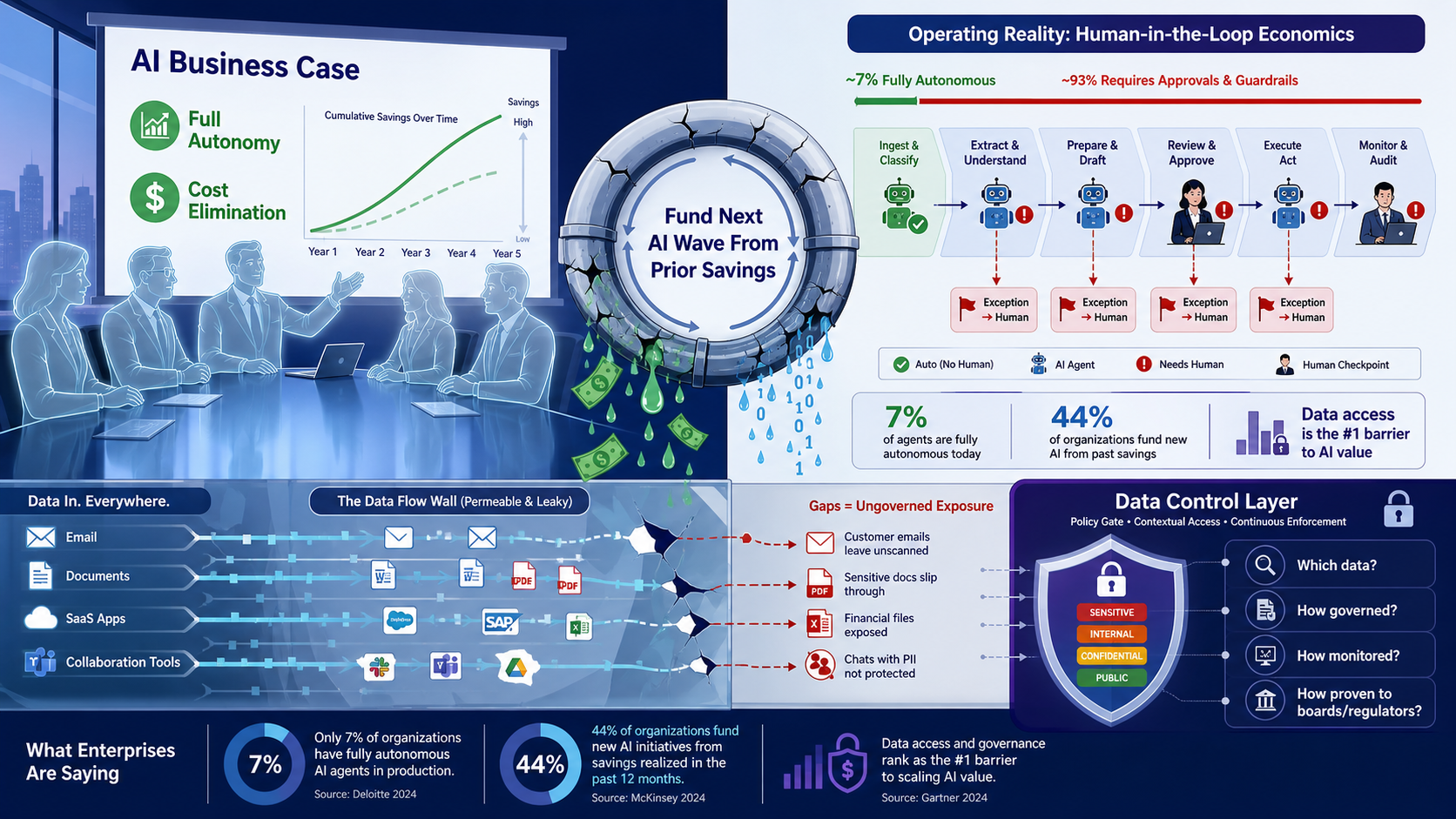
Bain Company’s survey shows only 7% of companies run fully autonomous agents today; most operate with human approvals, guardrails, and exceptions. Yet AI business cases are still written as if agents will replace entire processes. Finance then funds new waves from savings that never materialized, while data risk compounds. The fix is rebuilding AI cases on real workflows, audited returns, and a concrete plan to control how AI uses your data.
One of the most revealing findings in Bain’s Automation & AI Pathfinder Survey is buried in the details: only 7% of companies are running fully autonomous agents in production. The dominant operating mode is far more human‑in‑the‑loop. Thirty‑eight percent of respondents rely on agents that require human approval, and another 32% use guardrails and exceptions where humans step in when AI isn’t confident.
Despite this, most AI business cases are still written as if full autonomy is around the corner. The numbers in the deck quietly assume that agents will handle complex decisions end‑to‑end, and that human involvement will shrink to near zero.
The reality on the ground has not caught up with that fiction.
Don't forget to check out our previous blog in this series here.
*********************
Human‑In‑The‑Loop Economics vs. Full‑Automation Assumptions
When you approve a business case based on full‑automation economics but deploy into a world where humans still approve, override, and rescue workflows, the financial model breaks immediately. Bain’s data suggests that this gap is wider in companies that miss their savings targets than in those that deliver them.
Under these conditions, AI is not a clean cost‑elimination play. It’s a leverage play. It changes how work is distributed between humans and systems, and how fast that work moves, but it does not erase the need for human judgment. If workflows, roles, and accountability stay the same as before, AI mostly adds complexity and cost on top of existing processes rather than unlocking transformational efficiency.
Closing that gap requires starting from the operating reality, not the aspirational slides: What decisions will still require human judgment? Where should agents escalate? What governance is needed when AI makes consequential choices? And how will those answers show up in the economics?
Bain’s study shows that the companies on the right side of the performance gap are doing exactly that—they are honest about the autonomy level of their agents and design their business cases, workflows, and governance structures accordingly.
The Circular Bet With a Structural Leak
Bain surfaces another financial risk that most organizations haven’t fully confronted: 44% of companies plan to fund generative AI and agentic AI investments from cost savings attributed to prior automation programs. On paper, that looks disciplined—self‑fund the next wave from returns earned in the last one.
The catch is that the prior wave underdelivered. The savings pool is smaller than assumed, yet the current investment cases are sized against projections rather than actuals. When you layer this onto the autonomy mismatch, you get a circular bet with a structural leak. Capital is being redeployed based on numbers that never really materialized, into systems whose risk footprint is expanding faster than governance and control.
That risk footprint is not abstract. As more AI systems connect to email, documents, SaaS apps, collaboration tools, and knowledge bases, the volume of sensitive data exposed to AI grows dramatically. Bain’s survey identifies data access and integration as the single biggest barrier to AI progress. The companies that are delivering on their targets feel this barrier more acutely precisely because they are deploying at scale.
If business cases don’t explicitly account for the cost and risk of governing that data access, the ROI story quickly becomes more fantasy than fact.
The Missing Layer: Concrete Control Over How AI Uses Your Data
This is where most AI business cases are thinnest: they describe what AI will do but say almost nothing about how data will be controlled as AI does it.
In the average enterprise today, AI adoption looks like copilots wiring into Microsoft 365, assistants reading messages and documents, internal GenAI apps training on “our data,” and agents calling tools and APIs at machine speed. Role‑based access control was never designed for this environment. If a user can see a file, an AI connected on their behalf often can too. If a system is reachable, an agent can potentially touch it.
Without a dedicated control layer between AI clients and enterprise data, business cases are implicitly assuming that existing controls are sufficient. Bain’s findings on data being the top barrier suggest they are not.
Rebuilding the AI business case on reality means answering, in detail:
- Which categories of data will AI be allowed to use?
- How will access be governed in real time, beyond simple user permissions?
- How will we monitor and enforce policy on content in motion, at rest, and in use inside AI workflows?
- How will we demonstrate to boards and regulators that AI‑era data risk is understood and controlled?
That is the layer platforms like Bonfy are designed to provide: mapping where sensitive, unstructured data lives, seeing how humans, applications, copilots, and agents interact with it, and enforcing contextual policies at the moment content is accessed, used, or generated.
With that in place, AI business cases can finally be built on audited returns, realistic autonomy, and a quantified, governed data risk profile rather than on hopeful assumptions. Bain’s study makes it clear that the companies pulling ahead are the ones making those organizational decisions; the ones stuck in the 0–10% band are still funding AI as if technology alone will close the gap.
The real turning point is not the next model upgrade. It’s the moment leadership decides to rebuild the AI business case on what the organization actually does—and on how its data is actually controlled.







%20(3).png?width=200&height=200&name=Bonfy-YB-Icon%20(200%20x%20200%20px)%20(3).png)